The T Cell Activation/Expansion Kit was developed to activate and expand human T cells. The kit consists of Anti-Biotin MACSiBead Particles and biotinylated antibodies against human CD2, CD3, and CD28. Anti-Biotin MACSiBead Particles loaded with the biotinylated antibodies are used to mimic antigen-presenting cells and activate resting T cells from PBMCs as well as purified T cells. T cell expansion is achieved by culturing and reactivation at day 14 of culture.


Related products for T Cell Activation/Expansion Kit, human

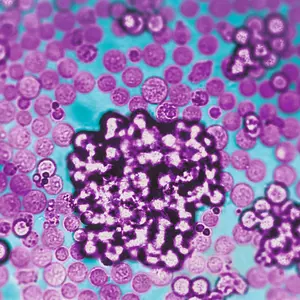
Anti-Biotin MACSiBead Particles were loaded with CD2, CD3, and CD28 antibodies. T cells were isolated using the Pan T Cell Isolation Kit. Purified T cells were activated for 72 hours using one loaded Anti-Biotin MACSiBead Particle per two T cells. The negative control experiment was performed without adding MACSiBead Particles. Cells were fluorescently stained using CD4-FITC and CD25-PE or CD4-PE and CD69-FITC.
The T Cell Activation/Expansion Kit was developed to activate and expand human T cells. The kit consists of Anti-Biotin MACSiBead Particles and biotinylated antibodies against human CD2, CD3, and CD28. Anti-Biotin MACSiBead Particles loaded with the biotinylated antibodies are used to mimic antigen-presenting cells and activate resting T cells from PBMCs as well as purified T cells. T cell expansion is achieved by culturing and reactivation at day 14 of culture.
Activated T cells can be used for any downstream processing, such as cytokine analysis1 or immunoprecipitation, and cells can also be transfected with high efficiency. The kit is suitable for the expansion of antigen-specific T cell lines and clones. It is also suitable for the activation of human CD3+CD56+ NKT cells.
- Camargo, J. F. et al. (2009) CCR5 expression levels influence NFAT translocation, IL-2 production, and subsequent signaling events during T lymphocyte activation. J Immunol 182: 171-182
- Diveu, C. et al. (2009) IL-27 blocks RORc expression to inhibit lineage commitment of Th17 cells. J Immunol 182: 5748-5756
- Duraisingham, S. S. et al. (2009) TLR-stimulated CD34 stem cell-derived human skin-like and monocyte-derived dendritic cells fail to induce Tʜ17 polarization of naive T cells but do stimulate Tʜ1 and Tʜ17 memory responses. J Immunol 183: 2242-2251
- Sattler, A. et al. (2009) Cytokine-induced human IFN-gamma-secreting effector-memory Th cells in chronic autoimmune inflammation. Blood 113: 1948-1956
- Lécureuil, C. et al. (2007) Trapping and apoptosis of novel subsets of memory T lymphocytes expressing CCR6 in the spleen of HIV-infected patients. Blood 109: 3649-3657
- Wieckowski, E. U. et al. (2009) Tumor-derived microvesicles promote regulatory T cell expansion and induce apoptosis in tumor-reactive activated CD8+ T lymphocytes. J Immunol 183: 3720-3730
- Acosta-Rodriguez, E. V. et al. (2007) Interleukins 1beta and 6 but not transforming growth factor-beta are essential for the differentiation of interleukin 17-producing human T helper cells. Nat Immunol 8: 942-948
You have previously chosen International as your location.
What do you want to do?