StemMACS iPS-Brew XF is a xeno-free cell culture medium for the maintenance of human ES and iPS cells under feeder-free conditions.


Related products for StemMACS™ iPS-Brew XF, human


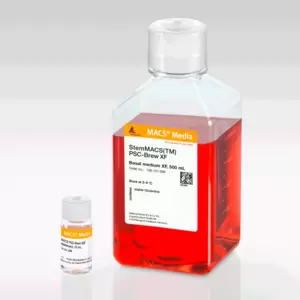
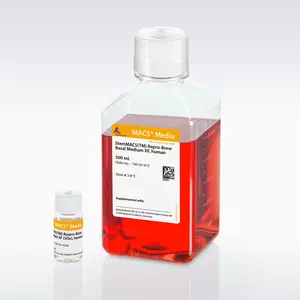
Pluripotent stem cells cultured in StemMACS iPS-Brew XF display typical colony morphology.
Cells cultured in StemMACS iPS-Brew XF maintain full pluripotent differentiation potential and can form teratomas containing derivatives of all three germ layers.
Human iPS cells cultured in StemMACS iPS-Brew XF show high expression of pluripotency markers.
StemMACS iPS-Brew XF is a xeno-free cell culture medium for the maintenance of human ES and iPS cells under feeder-free conditions.
StemMACS iPS-Brew XF is a xeno-free cell culture media formulation for the maintenance and expansion of human pluripotent stem cells under feeder-free conditions. The formulation supports rapid adaption of feeder-based cell cultures to a feeder-free environment and is compatible with commonly used cell attachment matrices, e.g. MACSmatrix Laminin 511 or Corning® Matrigel®. StemMACS iPS-Brew XF enables robust and efficient expansion of human embryonic stem (ES) cells or induced pluripotent stem (iPS) cells over multiple passages while maintaining a pluripotent phenotype as well as pluripotent differentiation potential. StemMACS iPS-Brew XF allows rapid culture re-initiation of pluripotent stem cell cultures after cryopreservation.
- Culture of human ES or iPS cells under xeno- and feeder-free conditions
- Rapid and easy adaption of feeder-based cell cultures to a feeder-free environment
- Rapid culture initiation after cryopreservation
- Mitzelfeld, K. et al. (2016) The human 343delT HSPB5 chaperone associated with early-onset skeletal myopathy causes defects in protein solubility. J. Biol. Chem. 291 (29): 14939-14953
- Si-Tayeb, K. et al. (2016) Urine‑sample‑derived human induced pluripotent stem cells as a model to study PCSK9‑mediated autosomal dominant hypercholesterolemia. Dis Model Mech 9 (1): 81-90
- Kirkeby, A. et al. (2017) Predictive markers guide differentiation to improve graft outcome in clinical translation of hESC-based therapy for Parkinson’s Disease. Cell Stem Cell 20: 1-14
- Nolbrant, S. et al. (2017) Generation of high-purity human ventral midbrain dopaminergic progenitors for in vitro maturation and intracerebral transplantation. Nat. Protoc. 12 (9): 1962-1979
- Lorenz, C. et al. (2017) Human iPSC-derived neural progenitors are an effective drug discovery model for neurological mtDNA disorders. Cell Stem Cell 20 (5): 659-674
- Es-Salah-Lamoureux, Z. et al. (2016) HIV-Tat induces a decrease in IKr and IKs via reduction in phosphatidylinositol-(4,5)-bisphosphate availability. J. Mol. Cell. Cardiol. 99: 1-13
- Giobbe, G. G. et al. (2015) Functional differentiation of human pluripotent stem cells on a chip. Nat. Methods 12: 637-640
- Park, C.-Y. et al. (2016) Three-dimensional imaging of solvent-cleared organs using 3DISCO. Nat. Protoc. 11: 2154-2169
You have previously chosen International as your location.
What do you want to do?