PepTivator® FMC63scFv (CD19) CAR Immunogenicity is a pool of lyophilized peptides, consisting mainly of 15-mer sequences with 11 amino acids (aa) overlap, covering the complete FMC63 scFV protein from GenBank No. QHQ73567.1. Additionally, the 4GS linker sequence was replaced by the Whitlow linker (see also Background information).
In vitro stimulation of antigen-specific T cells with PepTivator Peptide Pools causes the secretion of effector cytokines and the up-regulation of activation markers, which then allow the detection and isolation of antigen-specific T


Related products for PepTivator® FMC63scFv (CD19) CAR Immunogenicity, human
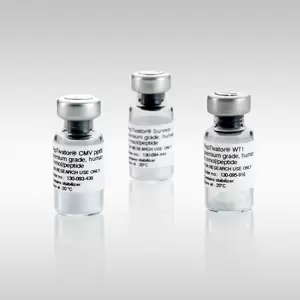


PepTivator® FMC63scFv (CD19) CAR Immunogenicity is a pool of lyophilized peptides, consisting mainly of 15-mer sequences with 11 amino acids (aa) overlap, covering the complete FMC63 scFV protein from GenBank No. QHQ73567.1. Additionally, the 4GS linker sequence was replaced by the Whitlow linker (see also Background information).
In vitro stimulation of antigen-specific T cells with PepTivator Peptide Pools causes the secretion of effector cytokines and the up-regulation of activation markers, which then allow the detection and isolation of antigen-specific T cells.
The FMC63scFv sequence is engineered from a monoclonal mouse antibody directed against the human CD19 protein. This sequence is commonly used as the ectodomain of CD19 targeting chimeric antigen receptor (CAR) sequences. CAR T cells, which express CARs containing this domain, are frequently applied for the treatment of B cell related leukemia and lymphoma. The FMC63 scFv protein mapped by this peptide pool is covered by GenBank Seq-No. QHQ73567.1. Thereby, the 4GS linker sequence aa 108-122 [GGGGSGGGGSGGGGS] was exchanged against the corresponding Whitlow linker sequence [GSTSGSGKPGSGEGSTKG], while the rest of the FMC63 scFv protein sequence is identical.
The PepTivator Peptide Pools have been specially developed for efficient in vitro stimulation of antigen-specific CD4+ and CD8+ T cells, as peptides of 15 amino acid length with 11 amino acid overlap represent the optimized solution for stimulating T cells in various applications. Stimulation of T cells with PepTivator Peptide Pools causes the secretion of effector cytokines and upregulation of activation markers, which then allows the detection or isolation of antigen-specific T cells. Quantitative, phenotypical, or functional analysis of antigen-specific T cell immunity can provide important information on the natural course of immune responses in healthy or immunocompromised individuals.
You have previously chosen International as your location.
What do you want to do?