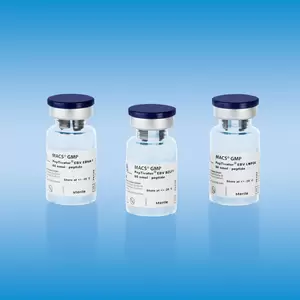
Stimulate T cells reactive to the large T (LT) antigen of the BK virus (BKV) using PepTivator Peptide Pools. PepTivators are pools of lyophilized peptides, consisting mainly of 15-mer sequences with 11 amino acids overlap. PepTivator® BKV LT is a pool of lyophilized peptides, covering the sequence of the BKV LT antigen (UniProtKB Acc. no. P14999).
The PepTivator is available in two different quality grades. The research-grade product has an average purity of 70%, whereas peptides of the premium-grade product are individually purified via HPLC having each a purity of >80%


Related products for PepTivator® BKV LT

Detection and isolation of viable BKV–specific T cells using MACS® IFN-γ Secretion Assay – Cell Enrichment and Detection Kit (PE)
From a BKV+ donor, 107 human peripheral blood mononuclear cells (PBMCs) were restimulated for 4 hours either with 20 μL/mL of reconstituted PepTivator® BKV LT1 (A), 20 µL/mL BKV VP1 (B), or a mixture of both peptide pools (C). BKV-specific T cells were stained and magnetically enriched according to their secretion of IFN-γ using the IFN-γ Secretion Assay – Cell Enrichment and Detection Kit (PE) (# 130-054-201). T cells were counterstained for CD4 and CD8 expression. Cell debris and dead cells are excluded from the analysis based on scatter signals and propidium iodide fluorescence. IFN-γ secretion of viable lymphocytes is shown.
Stimulate T cells reactive to the large T (LT) antigen of the BK virus (BKV) using PepTivator Peptide Pools. PepTivators are pools of lyophilized peptides, consisting mainly of 15-mer sequences with 11 amino acids overlap. PepTivator® BKV LT is a pool of lyophilized peptides, covering the sequence of the BKV LT antigen (UniProtKB Acc. no. P14999).
The PepTivator is available in two different quality grades. The research-grade product has an average purity of 70%, whereas peptides of the premium-grade product are individually purified via HPLC having each a purity of >80%.
In vitro stimulation of antigen-specific T cells with PepTivator Peptide Pools causes the secretion of effector cytokines and the up-regulation of activation markers, which then allow the detection and isolation of antigen-specific T cells.
BK virus (BKV) is a ubiquitous polyomavirus closely related to the JC polyomavirus (JCV). After primary infection of humans, BKV persists in a latent state especially in the kidney and the urinary tract. In healthy individuals the infection is asymptomatic, but in immunocompromised patients virus reactivation may occur, which then can cause, e.g., haemorrhagic cystitis after allogenic stem cell transplantation or loss of the allograft after renal transplantation. The large T antigen (LT) is a protein expressed early in the lytic cycle, initiating viral replication. It has been shown to be a target of T cell immunity.
PepTivator BKV LT has been specifically developed for efficient in vitro stimulation of BKV LT–specific T cells. Peptides of 15 amino acids in length and 11 amino acids overlap represent an optimized solution for stimulating both CD4+ and CD8+ T cells in various applications, including:
- Detection and analysis of BKV LT–specific effector/memory T cells in PBMCs by MACS® Cytokine Secretion Assays, intracellular cytokine staining, or other technologies.
- Isolation of viable BKV LT–specific CD4+ T cells with the CD154 MicroBead Kit, or of CD4+ and CD8+ T cells using the CD137 MicroBead Kit or MACS Cytokine Secretion Assay – Cell Enrichment and Detection Kits. Subsequently, cells can be expanded for generation of T cell lines.
- Generation of BKV LT–specific effector/memory T cells from naive T cell populations.
- Pulsing of antigen-presenting cells.
- Hopfner, F. et al. (2021) Allogeneic BK Virus-Specific T-Cell Treatment in 2 Patients With Progressive Multifocal Leukoencephalopathy. Neurol Neuroimmunol Neuroinflamm. 8 (4): e1020
You have previously chosen International as your location.
What do you want to do?