The Mitochondria Isolation Kit, human facilitates the isolation of functional and viable mitochondria from human cells or tissue. The isolation protocol is based on the renowned MACS Technology, which enables fast isolation of high purity and high yield mitochondria.


Related products for Mitochondria Isolation Kit, human
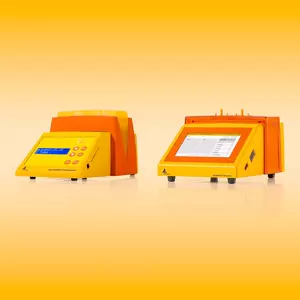

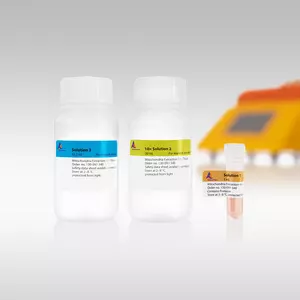
Principle of the isolation of human mitochondria using MACS Technology.
Mitochondrial protein import is maintained after magnetic isolation. Mitochondria were prepared using the Mitochondria Isolation Kit, human or by differential centrifugation (DC) and were then incubated for 1 h with 35S-labeled TFAM. Import was studied by SDS-PAGE and fluorography. Lane 1: Control lysate of in vitro translated TFAM. Lane 2-7: Proteins from sedimented mitochondria. P= Precursor protein. M= Imported mature protein. (Courtesy of Dr. H.-T. Hornig-Do, Newcastle, UK)
Purest mitochondria preparation. Mitochondria were prepared by different protocols. Amounts of COX I (mitochondria) and KDEL (endoplasmic reticulum) in the mitochondrial fractions obtained using differential centrifugation (DC), Mitochondria Isolation Kit, human, and ultracentrifugation (UC) were analyzed by Western blotting. Compared to DC and UC, mitochondria isolated with the Mitochondria Isolation Kit, human have no detectable contamination with ER. (Courtesy of Dr. H.-T. Hornig-Do, Newcastle, UK)
The Mitochondria Isolation Kit, human facilitates the isolation of functional and viable mitochondria from human cells or tissue. The isolation protocol is based on the renowned MACS Technology, which enables fast isolation of high purity and high yield mitochondria.
The Mitochondria MidiMACS Starting Kit, human includes:
- 1 Mitochondria Isolation Kit, human
- 1 MidiMACS Separator
- 1 MACS MultiStand
The Mitochondria QuadroMACS Starting Kit, human includes:
- 1 Mitochondria Isolation Kit, human
- 1 QuadroMACS Separator
- 1 MACS MultiStand
After cell lysis, mitochondria are magnetically labeled with Anti-TOM22 MicroBeads, human, which bind to the translocase of the outer mitochondrial membrane 22 protein (TOM22). The sample is loaded onto an LS Column placed in a MidiMACS or QuadroMACS Separator. After washing, only magnetically labeled mitochondria are retained on the column. The column is removed from the separator and functional human mitochondria are eluted from the column.
After isolation mitochondria can be further subjected to Western blot analysis1,6 or downstream functional assays, including measurement of O2, membrane potential, and ATP4-5,7, or respiratory control4. Growing evidence also suggests that isolated mitochondria are well suited for mitochondrial RNA expression profiling studies2,3.
To access a Safety Data Sheet for a hazardous product or component in English or Swedish language, follow the link below and enter the catalog number of the product.
Please note, that the Safety Data Sheet has a cover sheet only in English language.
Should you wish a Safety Data Sheet (SDS) in other languages than English or Swedish, please contact Technical Support.
- Eriksen, M. B. et al. (2011) Intact primary mitochondrial function in myotubes established from women with PCOS. J. Clin. Endocrinol. Metab. 96 (8): E1298-1302
- Sacchi, S. et al. (2011) Evidence for the interaction of d-amino acid oxidase with pLG72 in a glial cell line. Mol. Cell. Neurosci. 48 (1): 20-28
- Minet, A. D. and Gaster, M. (2011) The dynamic equilibrium between ATP synthesis and ATP consumption is lower in isolated mitochondria from myotubes established from type 2 diabetic subjects compared to lean control. Biochem. Biophys. Res. Commun. 409 (4): 591-595
- Bandiera, S. et al. (2011) Nuclear outsourcing of RNA interference components to human mitochondria. PLoS One 6 (6): e20746
- Minet, A. D. and Gaster, M. (2010) ATP synthesis is impaired in isolated mitochondria from myotubes established from type 2 diabetic subjects. Biochem. Biophys. Res. Commun. 402 (1): 70-74
- Hornig-Do, H. T. et al. (2012) Nonsense mutations in the COX1 subunit impair the stability of respiratory chain complexes rather than their assembly. EMBO J. 31 (5): 1293-1307
- Hornig-Do, H. T. et al. (2009) Isolation of functional pure mitochondria by superparamagnetic microbeads. Anal. Biochem. 389 (1): 1-5
- Papkovskaia, T. D. et al. (2012) G2019S leucine-rich repeat kinase 2 causes uncoupling protein-mediated mitochondrial depolarization. Hum. Mol. Genet. 21 (19): 4201-4213
- Barrey, E. et al. (2011) Pre-microRNA and mature microRNA in human mitochondria. PLoS One 6 (5): e20220
- Guo, T. et al. (2010) Quantitative proteomics discloses MET expression in mitochondria as a direct target of MET kinase inhibitor in cancer cells. Mol. Cell. Proteomics 9 (12): 2629-2641
- Schiller, M. et al. (2012) Induction of type I IFN is a physiological immune reaction to apoptotic cell-derived membrane microparticles. J Immunol 189 (4): 1747-1756
- Mukhopadhyay, P. et al. (2012) Mitochondrial reactive oxygen species generation triggers inflammatory response and tissue injury associated with hepatic ischemia-reperfusion: therapeutic potential of mitochondrially-targeted antioxidants. Free Radic. Biol. Med. 53 (5): 1123-1138
You have previously chosen International as your location.
What do you want to do?