The Mix and Match Basic Kits contain the essential consumables and supplements required to perform a customized MACSPlex Cytokine Mix and Match assay, including the filter plate, adhesive foils, and buffers. This assay allows the flexible selection and simultaneous measurement of 1 to 7 soluble analytes within a single sample using bead-based multiplexed flow cytometry. The MACSPlex cytokine platform is compatible with any standard flow cytometer. Detailed instructions on how to design a MACSPlex Mix and Match Assay can be found below.


Related products for MACSPlex Cytokine Mix and Match, Basic Kits
Figure 1: How to assemble a MACSPlex Cytokine Mix and Match Assay. Please choose one of our pre-defined panels as a basis for your custom MACSPlex assay: 1) human cytokine, 2) human cytotoxicity, or 3) mouse cytokine panel. It is not possible to combine analytes from one panel with analytes from another panel. Next, select the matching Basic Kit and Standard Kit together with 1 to 7 analytes from your chosen panel.
The Mix and Match Basic Kits contain the essential consumables and supplements required to perform a customized MACSPlex Cytokine Mix and Match assay, including the filter plate, adhesive foils, and buffers. This assay allows the flexible selection and simultaneous measurement of 1 to 7 soluble analytes within a single sample using bead-based multiplexed flow cytometry. The MACSPlex cytokine platform is compatible with any standard flow cytometer. Detailed instructions on how to design a MACSPlex Mix and Match Assay can be found below.
In order to assemble a customized MACSPlex Cytokine Mix and Match assay, you will have to combine three products (see Table 1 below):
- 1. one basic kit
- 2. one standard kit
- 3. an individual selection of up to 7 MACSPlex cytokine reagents from one of our three predefined panels: human cytokine panel, human cytotoxicity panel, or mouse cytokine panel
The basic kits contain general supplements necessary to perform the multiplex assay (filter plate, adhesive foils, and buffers), the standard kits contain lyophilized analytes for serial dilution and standard curve generation, and the MACSPlex cytokine reagents contain analyte-specific fluorescence-coded bead populations for analyte capture and detection. To select the correct basic and standard kit for your panel, please refer to Table 1 below.
Choose the panel that corresponds to your sample species (human or murine) and includes the analytes relevant to your application. Please note that analytes from different panels cannot be combined.
MACSPlex Cytokine technology utilizes MACSPlex Capture Beads, which exhibit defined fluorescence profiles in the FITC and PE channels and are coated with specific antibodies against soluble analytes. During incubation with a sample, these beads selectively bind their target analytes from the solution.
Following analyte capture, detection antibodies are added to form analyte-specific sandwich complexes. These antibodies are either directly conjugated to APC (direct detection) or to biotin (indirect detection). For indirect detection, a subsequent incubation with an APC-conjugated anti-biotin antibody is required. An illustration of the MACSPlex assay principle is shown in the Data and images tab (Figure 1).
The resulting complexes - comprising Capture Beads, analytes, and detection antibodies - are analyzed by flow cytometry to quantify analyte concentrations. Analysis requires a flow cytometer with a blue (e.g., 488 nm) and a red (e.g., 635 nm) laser, which are capable of detecting FITC, PE, and APC channels. For accurate quantification, the MACSPlex assay includes predefined standards used to generate analyte-specific standard curves.
In addition, the Express Mode function on MACSQuant® Analyzers enables automated gating and analysis of MACSPlex Cytokine Mix and Match data. Express Modes are optimized for fully automated bead acquisition and analysis. Predefined experiment settings and built-in acquisition and analysis templates streamline the flow cytometric workflow. The software applies an automated gating strategy that dynamically adjusts to each data file to ensure optimal results.
Technical specifications
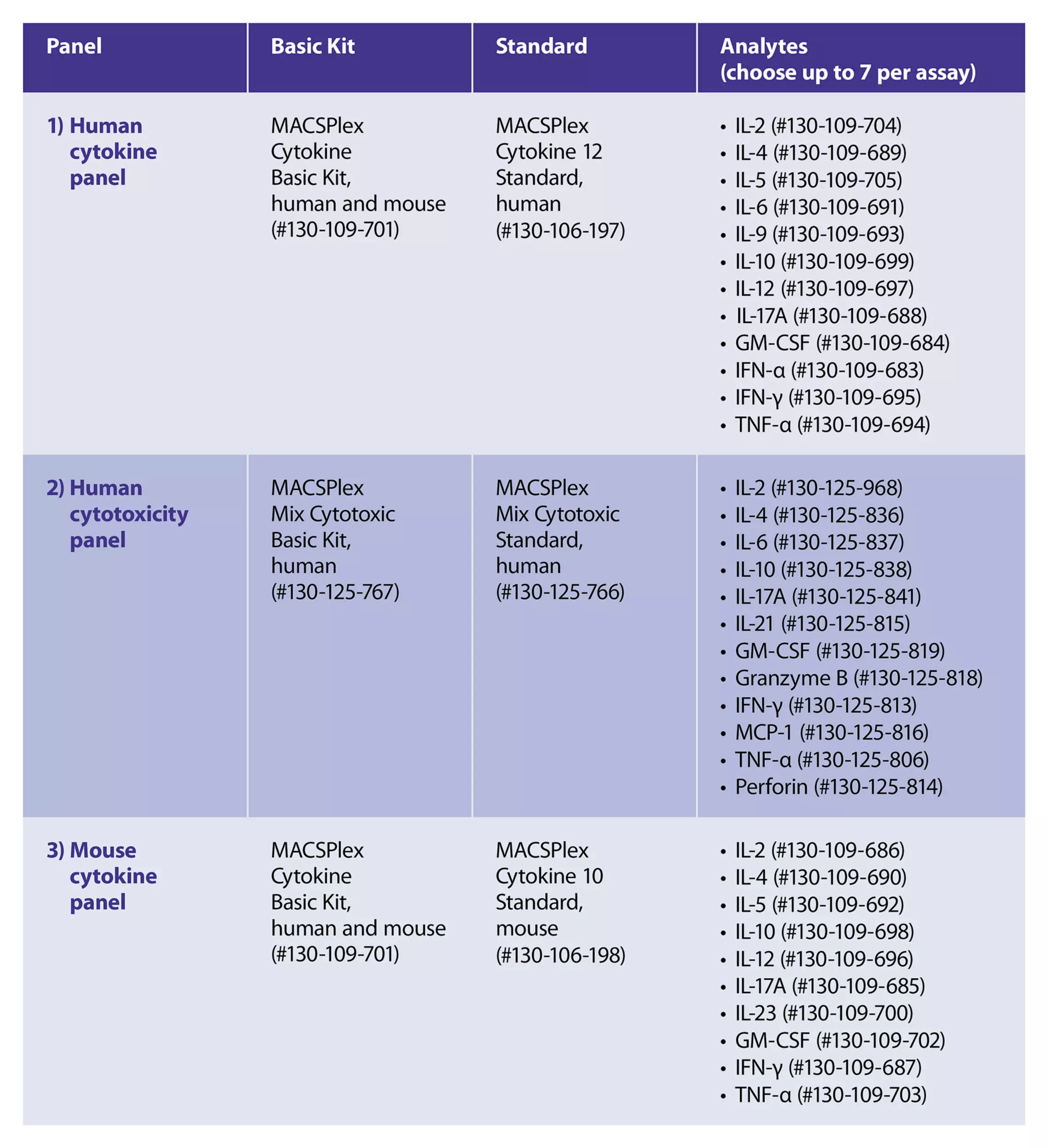
Table 1: How to assemble a MACSPlex Cytokine Mix and Match Assay. Please choose one of our pre-defined panels as a basis for your custom MACSPlex assay: 1) human cytokine, 2) human cytotoxicity, or 3) mouse cytokine panel. It is not possible to combine analytes from one panel with analytes from another panel. Next, select the matching Basic Kit and Standard Kit together with 1 to 7 analytes from your chosen panel.
To access a Certificate of Analysis (CoA) follow the link below and enter the specific lot of your product.
Should you wish to request additional documentation, such as a Safety Data Sheet (SDS) in other languages than English or Swedish, an SDS-replacement document, or a Certificate of Origin (CoO), please direct your inquiry to your local technical support team.
- Huppert, V. et al. (2017) Influence of irradiated peripheral blood mononuclear cells on both ex vivo proliferation of human natural killer cells and change in cellular property. Front Immunol 8: 854
- Ria, F. et al. (2016) Toll-Like Receptor 2 Mediates In Vivo Pro- and Anti-inflammatory Effects of Mycobacterium Tuberculosis and Modulates Autoimmune Encephalomyelitis. Front Immunol 7: 191
You have previously chosen International as your location.
What do you want to do?