Recombinant Human SHH (Sonic Hedgehog; or C24II) can promote growth and differentiation of embryonic stem cells, adult mesenchymal stem cells, and cells within the neuronal lineage. The morphogenetic cytokine is crucial for embryonic development, as it is involved in the patterning of the central nervous system, somites, and limbs. Recombinant Human SHH is ideal for use in cell culture, differentiation studies, and functional assays.


Related products for Human SHH (C24II)
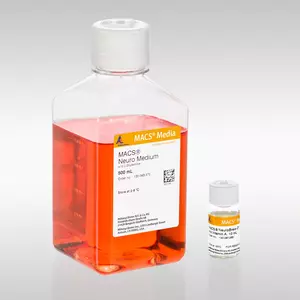
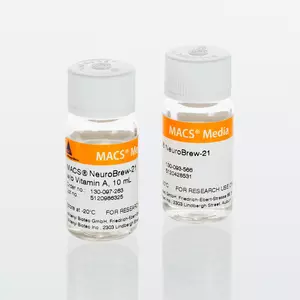
Neural precursors, derived from mouse embryonic stem cells, were expanded in MACS Neuro Medium containing N2-supplements, laminin, Human FGF-2 (10 ng/mL), Human SHH (C24II) (200 ng/mL), and FGF-8b (100 ng/mL). Subsequently cells were grown in MACS Neuro Medium complemented by MACS NeuroBrew-21 and ascorbic acid (200 µM) for final differentiation into neurons. Cells were analyzed by immunocytochemistry for TuJ1, TH, and GAD67 expression.
Human SHH (C24II) activity assay. The biological activity of Human SHH (C24II) is determined by a Luciferase Reporter Assay using a Gli Luciferase Reporter NIH3T3 cell line.
SDS-PAGE of Human SHH (C24II), premium grade under reducing (R) and non-reducing (NR) conditions.
Mass spectrometry analysis (ESI-MS) of Human SHH (C24II), premium grade. The peak corresponds to the calculated molecular mass of 19683 Da.
Recombinant Human SHH (Sonic Hedgehog; or C24II) can promote growth and differentiation of embryonic stem cells, adult mesenchymal stem cells, and cells within the neuronal lineage. The morphogenetic cytokine is crucial for embryonic development, as it is involved in the patterning of the central nervous system, somites, and limbs. Recombinant Human SHH is ideal for use in cell culture, differentiation studies, and functional assays.
Human SHH (C24II) can be used for a variety of applications including:
- Expansion or differentiation of various cell types, mainly human and mouse embryonic stem cells, but also adult stem cells and mesenchymal cells.
Biological activity
Sonic hedgehog (SHH) is involved in a wide variety of embryonic developmental events, including neurogenesis, limb development, hematopoiesis, and gut formation. Besides their role as morphogens, hedgehog family members have also been shown to act as mitogens, cell survival factors, and axon guidance factors and to influence tissue regeneration within the adult. SHH is synthesized as a precursor, which is autocatalytically cleaved into a 19 kDa N-terminal domain (SHH-N) and a 25 kDa C-terminal domain (SHH-C). SHH-N is responsible for the signaling activity of hedgehog proteins, while SHH-C acts as a cholesterol transferase and covalently attaches a cholesterol molecule to SHH-N. The lipid-modified SHH-N displays enhanced activity. Human SHH (C24II) corresponds to the mature SHH-N domain and carries a Cys to Ile-Ile substitution resulting in a lipophilic moiety and therefore an increased activity.
Research-grade cytokines are suitable for a wide variety of cell culture applications. They are sterile-filtered prior to lyophilization. Generally, endotoxin levels are <0.1 ng/μg (<1 EU/μg), and purities are >95%. The biological activity is tested in appropriate bioassays.
Premium-grade cytokines offer the convenience of high and well-defined biological activities and allow exact unit dosing for demanding applications. The biological activity is determined after lyophilization and reconstitution, and normalized to WHO/NIBSC standards whenever available. In general, endotoxin levels are <0.01 ng/μg (<0.1 EU/μg), and purities are >97%. Lot-specific activities are stated in the Certificate of Analysis (www. miltenyibiotec.com/certificates).
To access a Certificate of Analysis (CoA) follow the link below and enter the specific lot of your product.
Should you wish to request additional documentation, such as a Safety Data Sheet (SDS) in other languages than English or Swedish, an SDS-replacement document, or a Certificate of Origin (CoO), please direct your inquiry to your local technical support team.
- Costa-Besada, M. A. et al. (2018) Paracrine and Intracrine Angiotensin 1-7/Mas Receptor Axis in the Substantia Nigra of Rodents, Monkeys, and Humans. Mol Neurobiol 55 (7): 5847
- Chen, Z. et al. (2018) Genetic Engineering of Human Embryonic Stem Cells for Precise Cell Fate Tracing during Human Lineage Development. Stem Cell Reports 11 (5): 1257
- Liu, L. et al. (2019) Protection of ZIKV infection-induced neuropathy by abrogation of acute antiviral response in human neural progenitors. Cell Death Differ. 26 (12): 2607
- Fukusumi, H. et al. (2021) Alpha-synuclein dynamics in induced pluripotent stem cell-derived dopaminergic neurons from a Parkinson's disease patient (PARK4) with SNCA triplication. FEBS Open Bio. 11 (2): 354-366
- Bell, S. et al. (2017) A Rapid Pipeline to Model Rare Neurodevelopmental Disorders with Simultaneous CRISPR/Cas9 Gene Editing. Stem Cells Transl Med 6 (3): 886-896
You have previously chosen International as your location.
What do you want to do?