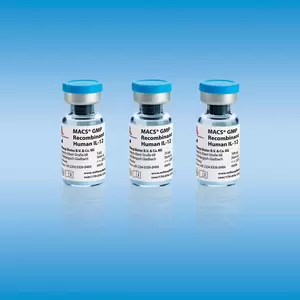
Recombinant human IL-12 (interleukin 12) can promote proliferation of NK and T cells, regulates their cytotoxic activity, and can induce Th1 differentiation of T cells. The T cell-stimulating factor IL-12 is a crucial regulator of cell mediated immune responses as it also induces the production of IFN-γ by PBMCs, among other cytokines. The recombinant protein is manufactured for use in differentiation studies, cell culture, and functional assays.


Related products for Human IL-12

Human IL-12 activity assay. The biological activity of Human IL-12 is determined by induction of IFN-γ secretion by PHA-activated T cells.
SDS-PAGE of Human IL-12, premium grade under reducing (R) and non-reducing (NR) conditions.
Recombinant human IL-12 (interleukin 12) can promote proliferation of NK and T cells, regulates their cytotoxic activity, and can induce Th1 differentiation of T cells. The T cell-stimulating factor IL-12 is a crucial regulator of cell mediated immune responses as it also induces the production of IFN-γ by PBMCs, among other cytokines. The recombinant protein is manufactured for use in differentiation studies, cell culture, and functional assays.
Human IL-12 can be used for a variety of applications, including:
- In vitro differentiation of naive CD4+ T cells towards TH1 cells.
- In vitro proliferation and stimulation of cytotoxic activity of NK cells and T cells.
Biological activity
Interleukin 12 (IL-12) is a heterodimeric proinflammatory cytokine and a modulator of cell-mediated immunity, which is mainly produced by macrophages, dendritic cells, and B cells. IL-12 stimulates the production and secretion of several cytokines, in particular IFN-γ, by NK cells and T cells, induces proliferation, and enhances the cytotoxic activity within these cell populations. Another important activity of IL-12, acting together with IFN-γ and IL-2, is to drive T helper cell responses toward the TH1 rather than the TH2 phenotype. Moreover, IL-12 is also important in resistance to viral disease and has significant antitumor activity. It has been shown that single chain fusion proteins of naturally occurring heterodimeric cytokines such as IL-12 or IL-23 are bioactive in vitro and in vivo.2,3
Premium-grade cytokines offer the convenience of high and well-defined biological activities and allow exact unit dosing for demanding applications. The biological activity is determined after lyophilization and reconstitution, and normalized to WHO/NIBSC standards whenever available. In general, endotoxin levels are <0.01 ng/μg (<0.1 EU/μg), and purities are >97%. Lot-specific activities are stated in the Certificate of Analysis (www.miltenyibiotec.com/certificates).
To access a Certificate of Analysis (CoA) follow the link below and enter the specific lot of your product.
Should you wish to request additional documentation, such as a Safety Data Sheet (SDS) in other languages than English or Swedish, an SDS-replacement document, or a Certificate of Origin (CoO), please direct your inquiry to your local technical support team.
- Bastien, J.-P. et al. (2020) Closing the system: production of viral antigen-presenting dendritic cells eliciting specific CD8 + T cell activation in fluorinated ethylene propylene cell culture bags. J. Transl. Med. 18 (1): 383
- Schurich, A. et al. (2016) Distinct Metabolic Requirements of Exhausted and Functional Virus-Specific CD8 T Cells in the Same Host. Cell Rep 16 (5): 1243-1252
- Gajdasik, D. W. et al. (2020) Th1 responses in vivo require cell-specific provision of OX40L dictated by environmental cues. Nat Commun 11 (1): 3421
- Lieschke, G. J. et al. (1997) Bioactive murine and human interleukin-12 fusion proteins which retain antitumor activity in vivo. Nat. Biotechnol. 15: 35-40
- Miller, J. M. et al. (2010) Vesicular stomatitis virus modified with single chain IL-23 exhibits oncolytic activity against tumor cells in vitro and in vivo. Int. J. Infereron Cytokine Mediator Res. 2010: 63-72
- Juelke, K. et al. (2010) CD62L expression identifies a unique subset of polyfunctional CD56dim NK cells. Blood 116 (8): 1299-1307
- Klasen, C. et al. (2019) Prostaglandin receptor EP4 expression by Th17 cells is associated with high disease activity in ankylosing spondylitis. Arthritis Res Ther. 21 (1): 159
- Wulff, H. et al. (2007) Cloning and characterization of an adenoviral vector for highly efficient and doxycycline-suppressible expression of bioactive human single-chain interleukin 12 in colon cancer. BMC Biotechnol. 7: 35
- Loyal, L. et al. (2020) SLAMF7 and IL-6R define distinct cytotoxic versus helper memory CD8 + T cells. Nat Commun 11 (1): 6357
- Rossi, G. R. et al. (2020) The Antitumor Effect of Heparin is not Mediated by Direct NK Cell Activation. J Clin Med 9 (8): 2666
- Wiegand, S. B. et al. (2019) Soluble immune markers in the different phases of chronic hepatitis B virus infection. Sci Rep 9 (1): 14118
- Polito, V. A. et al. (2019) Universal Ready-to-Use Immunotherapeutic Approach for the Treatment of Cancer: Expanded and Activated Polyclonal γδ Memory T Cells. Front Immunol 10: 2717
- Frumento, G. et al. (2019) CD117 (c-Kit) Is Expressed During CD8 + T Cell Priming and Stratifies Sensitivity to Apoptosis According to Strength of TCR Engagement. Front Immunol 10: 468
- Chiurchiù, V. et al. (2016) Proresolving lipid mediators resolvin D1, resolvin D2, and maresin 1 are critical in modulating T cell responses. Sci Transl Med 8 (353): 353ra111
You have previously chosen International as your location.
What do you want to do?