CD56 is an isoform of the neural cell adhesion molecule (NCAM). Among human hematopoietic cell populations it is expressed on natural killer (NK) cells, natural killer T (NKT) cells, and on subpopulations of T cells, monocytes, and dendritic cells.
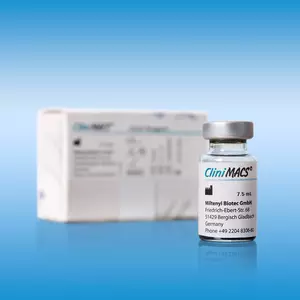
The CliniMACS® CD56 Product Line consists of murine anti-CD56 monoclonal antibodies conjugated to superparamagnetic iron dextran particles.
One vial contains 7.5 mL sterile, non-pyrogenic solution.
The performance of the CliniMACS CD56 Product Line depends on the individual separation strategy. For information on resp


Related products for CliniMACS® CD56 Product Line
Flow cytometric analysis of CD56–enriched cells using the CliniMACS CD56 System.
Flow cytometric analysis of CD3–depleted cells (B) followed by the analysis of CD56-enriched cells (C) using the CliniMACS CD3/CD56 System.
CD56 is an isoform of the neural cell adhesion molecule (NCAM). Among human hematopoietic cell populations it is expressed on natural killer (NK) cells, natural killer T (NKT) cells, and on subpopulations of T cells, monocytes, and dendritic cells.
The CliniMACS® CD56 Product Line consists of murine anti-CD56 monoclonal antibodies conjugated to superparamagnetic iron dextran particles.
One vial contains 7.5 mL sterile, non-pyrogenic solution.
The performance of the CliniMACS CD56 Product Line depends on the individual separation strategy. For information on respective capacities, refer to the CliniMACS User Manual or contact your local representative.
Please inquire about required CliniMACS System components and accessories.
The CliniMACS CD56 Product Line was developed for the enrichment of NK and NKT cells from human heterogeneous hematologic cell populations in combination with the CliniMACS® System.
In order to enrich CD56+CD3– NK cells, the CliniMACS CD56 Reagent is used in combination with the CliniMACS CD3 Reagent. In this approach, the cellular product is first depleted of CD3+ cells and subsequently enriched for CD56.1,2
NK cells and NKT cells may be a perfect tool to exert GvT effects in the transplant as well as in the non-transplant setting, since they have not been observed to induce GvHD. NK cell donor lymphocyte infusions (DLIs) have been infused in non-transplant and in haploidentical and unrelated donor PBSC transplantation settings in order to explore GvT effects.
Furthermore, the capacity to reduce risk for GvHD and early relapse of hematological malignant diseases (e.g. AML, CML) and the potential to emend an unstable donor chimerism after stem cell transplantation (SCT) are under clinical investigation.3–19
The CliniMACS® System components, including Reagents, Tubing Sets, Instruments, and PBS/EDTA Buffer, are designed, manufactured and tested under a quality system certified to ISO 13485.
In the EU, the CliniMACS System components are available as CE-marked medical devices for their respective intended use, unless otherwise stated. The CliniMACS Reagents and Biotin Conjugates are intended for in vitro use only and are not designated for therapeutic use or direct infusion into patients. The CliniMACS Reagents in combination with the CliniMACS System are intended to separate human cells. Miltenyi Biotec as the manufacturer of the CliniMACS System does not give any recommendations regarding the use of separated cells for therapeutic purposes and does not make any claims regarding a clinical benefit. For the manufacturing and use of target cells in humans the national legislation and regulations - e.g., for the EU the Directive 2004/23/EC ("human tissues and cells"), or the Directive 2002/98/EC ("human blood and blood components") - must be followed. Thus, any clinical application of the target cells is exclusively within the responsibility of the user of a CliniMACS System.
In the US, the CliniMACS CD34 Reagent System, including the CliniMACS Plus Instrument, CliniMACS CD34 Reagent, CliniMACS Tubing Sets TS and LS, and the CliniMACS PBS/EDTA Buffer, is FDA approved as a Humanitarian Use Device (HUD), authorized by U.S. Federal law for use in the treatment of patients with acute myeloid leukemia (AML) in first complete remission. The effectiveness of the device for this indication has not been demonstrated. Other products of the CliniMACS Product Line are available for use only under an approved Investigational New Drug (IND) application, Investigational Device Exemption (IDE) or FDA approval.
CR/GMP products are for ex vivo cell processing only, and are not intended for human in vivo applications. CR/GMP products are designed, manufactured and tested under an ISO 13485 quality management system and are in compliance with relevant GMP guidelines. They are designed following the recommendations of USP <1043> on ancillary materials. The manufacturing and testing of CR/GMP products of biological origin are in compliance with EP chapter 5.2.12 for “Raw materials of biological origin for the production of cell-based and gene therapy medicinal products”.
To access a Certificate of Analysis (CoA) follow the link below and enter the specific lot of your product.
Should you wish to request additional documentation, such as a Safety Data Sheet (SDS) in other languages than English or Swedish, an SDS-replacement document, or a Certificate of Origin (CoO), please direct your inquiry to your local technical support team.
- Rizzieri, D. A. et al. (2010) Natural killer cell-enriched donor lymphocyte infusions from A 3-6/6 HLA matched family member following nonmyeloablative allogeneic stem cell transplantation. Biol. Blood Marrow Transplant. 16 (8): 1107-1114
- Ruggeri, L. et al. (2002) Effectiveness of donor natural killer cell alloreactivity in mismatched hematopoietic transplants. Science 295: 2097-2100
- Rubnitz, J. E. et al. (2010) NKAML: a pilot study to determine the safety and feasibility of haploidentical natural killer cell transplantation in childhood acute myeloid leukemia. J. Clin. Oncol. 28 (6): 955-959
- Duwendag et al. (2004) 20th Int. NK Cell Workshop, Noordwijkerhout, NL.
- Passweg, J. R. et al. (2004) Purified donor NK-lymphocyte infusion to consolidate engraftment after haploidentical stem cell transplantation. Leukemia 18: 1835-1838
- Huenecke, S. et al. (2010) IL-2-driven regulation of NK cell receptors with regard to the distribution of CD16+ and CD16– subpopulations and in vivo influence after haploidentical NK cell infusion. J Immunother 33 (2): 200-210
- Teofili, L. et al. (2007) Different STAT-3 and STAT-5 phosphorylation discriminates among Ph-negative chronic myeloproliferative diseases and is independent of the V617F JAK-2 mutation. Blood 110: 354
- Iyengar, R. et al. (2003) Purification of human natural killer cells using a clinical-scale immunomagnetic method. Cytotherapy 5 (6): 479-484
- Leung, W. et al. (2004) Determinants of antileukemia effects of allogeneic NK cells. J Immunol 172: 644-650
- Koehl, U. et al. (2004) IL-2 activated NK cell immunotherapy of three children after haploidentical stem cell transplantation. Blood Cells Mol. Dis. 33: 261-266
- Miller, J. S. et al. (2005) Successful adoptive transfer and in vivo expansion of human haploidentical NK cells in patients with cancer. Blood 105: 3051-3057
- Curti, A. et al. (2007) Modulation of tryptophan catabolism by human leukemic cells results in the conversion of CD25- into CD25+ T regulatory cells. Blood 109: 2871
- Giebel, S. et al. (2003) Survival advantage with KIR ligand incompatibility in hematopoietic stem cell transplantation from unrelated donors. Blood 102: 814-819
- Passweg, J. R. et al. (2006) Preemptive Immunotherapy with Highly Purified CD56+/CD3− Natural Killer Cells after Haploidentical Stem Cell Transplantation. A Prospective Phase II Study in 2 Centers. Blood 108: 411
You have previously chosen International as your location.
What do you want to do?