The Anti-Cytokeratin MicroBeads, human have been developed for the positive selection of human carcinoma cells after dissociation of human FFPE tumor tissue.


Related products for Anti-Cytokeratin MicroBeads, human
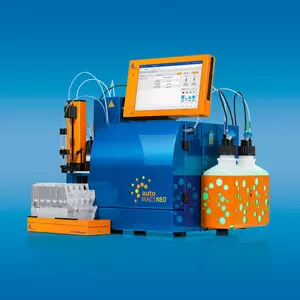



Human carcinoma cells were purified from a mixture of dissociated FFPE tumor cells spiked in dissociated FFPE spleen cells using Anti-Cytokeratin MicroBeads, human. Isolation was performed on an autoMACS® Pro Separator. The cells were fluorescently stained with Anti-Cytokeratin-FITC, Anti-Vimentin-APC, and CD235a (Glycophorin A)-PE, and DAPI and analyzed by flow cytometry using the MACSQuant® Analyzer.
Aggregates were excluded from the analysis based on scatter signals and single cells were gated on DAPI fluorescence.
The Anti-Cytokeratin MicroBeads, human have been developed for the positive selection of human carcinoma cells after dissociation of human FFPE tumor tissue.
Worldwide, FFPE tissues are considered the standard specimen for histopathological procedures and retrospective studies aiming to investigate human solid cancers.
Tumor cells in biopsy samples are usually surrounded by numerous noncancer cells, including tumor-infiltrating leukocytes (TILs) and fibroblasts. The presence of these cells potentially hamper the analysis of neoplastic cells.
An effective enrichment of the tumor ratio is therefore of utmost importance.
Most malignant cells, which originate in epithelial tissue express cytokeratins 7/8/18/19 and can be recognized by an anti-cytokeratin antibody1. The Anti-Cytokeratin MicroBeads, human guarantee an effective isolation of human carcinoma cells after dissociation of human FFPE tumor tissue.
Purified human carcinoma cells isolated via MACS® Technology can be used for sensitive downstream analyses, such as DNA sequencing by Next Generation Sequencing, flow cytometry, and immunofluorescence (IF).
MS or autoMACS® Columns.
- Heatley, M. et al. (1995) Cytokeratin intermediate filament expression in benign and malignant breast disease. J Clin Pathol 48: 26-32
You have previously chosen International as your location.
What do you want to do?