Anti-ACSA-2 MicroBeads (ACSA-2: astrocyte cell surface antigen-2) have been developed for the isolation or depletion of primary mouse astrocytes based on the expression of the ACSA-2 antigen. The protocol can be performed within only one hour.


Related products for Anti-ACSA-2 MicroBead Kit, mouse


ACSA-2+ cells were isolated from P4 CD-1 mouse brain tissue using the Neural Tissue Dissociation Kit (P), the gentleMACS™ Dissociator, FcR Blocking Reagent, mouse, Anti-ACSA-2 MicroBeads, a MiniMACS™ Separator, and an MS Column. Cells were fluorecently stained with Anti-ACSA-2-PE and analyzed by flow cytometry using the MACSQuant® Analyzer. Cell debris and dead cells were excluded from the analysis based on scatter signals and propidium iodide fluorescence.
Anti-ACSA-2 MicroBeads (ACSA-2: astrocyte cell surface antigen-2) have been developed for the isolation or depletion of primary mouse astrocytes based on the expression of the ACSA-2 antigen. The protocol can be performed within only one hour.
The ACSA-2 antigen is specifically expressed on GLAST (ACSA-1) positive astrocytes and is therefore an exclusive marker of astrocytes in the developing and neonatal mouse central nervous system (CNS). The Anti-ACSA-2 MicroBeads allow also for purification of astrocytes that show weak GLAST (ACSA-1) expression.
The percentage of ACSA-2 positive astrocytes differs according to the mouse age and the brain region used for the cell isolation.
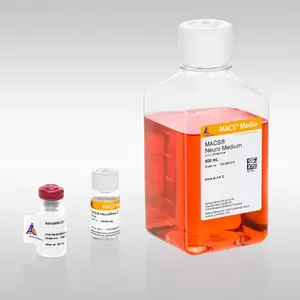
The isolation of primary astrocytes was tested particularly on dissociated postnatal CD-1 mouse brain tissue derived from animals younger than postnatal day 8 (P8). The protocol can be performed in only one hour. The astrocytes show excellent morphology in culture using MACS® Neuro Medium, MACS® NeuroBrew-21 with P/S and L-glutamine.
- Feldmann, M. et al. (2014) Isolating astrocytes and neurons sequentially from postnatal murine brains with a magnetic cell separation technique. J. Biol. Methods 1 (2): e11
- G. Kantzer, C. et al. (2017) Anti-ACSA-2 defines a novel monoclonal antibody for prospective isolation of living neonatal and adult astrocytes. Glia 65 (6): 990-1004
- Sharma, K. et al. (2015) Cell type- and brain region-resolved mouse brain proteome. Nat. Neurosci. 18 (12): 1819-1831
- Holt, L. M. and Olsen, M. L. (2016) Novel applications of magnetic cell sorting to analyze cell-type specific gene and protein expression in the central nervous system. PLoS One 11 (2): e0150290
- Batiuk, M. Y. et al. (2017) An immunoaffinity-based method for isolating ultrapure adult astrocytes based on ATP1B2 targeting by the ACSA-2 antibody. J. Biol. Chem. 292 (21): 8874-8891
You have previously chosen International as your location.
What do you want to do?