Recombinant human M-CSF can regulate the proliferation, differentiation, and survival of monocytes, macrophages, osteoclasts and their hematopoietic progenitors . The macrophage colony-stimulating factor (M-CSF) is a potent hematopoietic cytokine that is involved in diverse processes, such as regulation of inflammatory responses, bone resorption, atherosclerosis or brain and placental development. M-CSF recombinant protein can be especially used in differentiation studies, cell culture and functional assays.


Related products for Human M-CSF

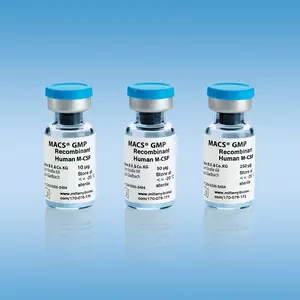
Recombinant human M-CSF can regulate the proliferation, differentiation, and survival of monocytes, macrophages, osteoclasts and their hematopoietic progenitors . The macrophage colony-stimulating factor (M-CSF) is a potent hematopoietic cytokine that is involved in diverse processes, such as regulation of inflammatory responses, bone resorption, atherosclerosis or brain and placental development. M-CSF recombinant protein can be especially used in differentiation studies, cell culture and functional assays.
Human M-CSF can be used for a variety of applications, including:
- Survival studies and apoptosis assays, for example, using peripheral blood monocytes.
- Differentiation of macrophages from peripheral blood monocytes.
- Differentiation of osteoclasts from CD14+ monocytes.
CSF1
Biological activity
Macrophage-colony stimulating factor (M-CSF), a four α-helical bundle cytokine, is a potent hematopoietic regulator. It is primarily produced by monocytes, granulocytes, endothelial cells, and fibroblasts. The main function of M-CSF is the regulation of proliferation, differentiation, and survival of monocytes, macrophages and their hematopoietic progenitors. Furthermore, M-CSF has been shown to play an important role in immunological defense, bone metabolism, fertility, and pregnancy.
Research-grade cytokines are suitable for a wide variety of cell culture applications. They are sterile-filtered prior to lyophilization. Generally, endotoxin levels are <0.1 ng/μg (<1 EU/μg), and purities are >95%. The biological activity is tested in appropriate bioassays.
Premium-grade cytokines offer the convenience of high and well-defined biological activities and allow exact unit dosing for demanding applications. The biological activity is determined after lyophilization and reconstitution, and normalized to WHO/NIBSC standards whenever available. In general, endotoxin levels are <0.01 ng/μg (<0.1 EU/μg), and purities are >97%. Lot-specific activities are stated in the Certificate of Analysis (www. miltenyibiotec.com/certificates).
Human M-CSF activity assay. The biological activity of Human M-CSF is determined by proliferation assay using NFS-60 cells.
SDS-PAGE of Human M-CSF, premium grade under reducing (R) and non-reducing (NR) conditions.
To access a Certificate of Analysis (CoA) follow the link below and enter the specific lot of your product.
Should you wish to request additional documentation, such as a Safety Data Sheet (SDS) in other languages than English or Swedish, an SDS-replacement document, or a Certificate of Origin (CoO), please direct your inquiry to your local technical support team.
- Lahaye, X. et al. (2018) NONO Detects the Nuclear HIV Capsid to Promote cGAS-Mediated Innate Immune Activation. Cell 175 (2): 488-501
- Queval, C. J. et al. (2014) A microscopic phenotypic assay for the quantification of intracellular mycobacteria adapted for high-throughput/high-content screening. J. Vis. Exp. (83)
- Giroud, P. et al. (2020) Expression of TAM-R in human immune cells and unique regulatory function of MerTK in IL-10 production by tolerogenic DC. Front Immunol 11: 564133
- Meissner, F. et al. (2010) Inflammasome activation in NADPH oxidase defective mononuclear phagocytes from patients with chronic granulomatous disease. Blood 116 (9): 1570-1573
- Michelet, X. et al. (2015) MHC class II presentation is controlled by the lysosomal small GTPase, Arl8b. J Immunol 194 (5): 2079-2088
- Hazlett, H. F. et al. (2020) Altered iron metabolism in cystic fibrosis macrophages: the impact of CFTR modulators and implications for Pseudomonas aeruginosa survival. Sci Rep 10 (1): 10935
- Fernandes, M. C. et al. (2016) Dual Transcriptome Profiling of Leishmania-Infected Human Macrophages Reveals Distinct Reprogramming Signatures. mBio. 7 (3)
- Dahlem, C. et al. (2020) Thioholgamide A, a New Anti-Proliferative Anti-Tumor Agent, Modulates Macrophage Polarization and Metabolism. Cancers (Basel) 12 (5): 1288
- Barosova, H. et al. (2020) Multicellular Human Alveolar Model Composed of Epithelial Cells and Primary Immune Cells for Hazard Assessment. J. Vis. Exp. (159)
- Wang, C. et al. (2010) Innate immune response to Mycobacterium tuberculosis Beijing and other genotypes. PLoS One 5 (10): e13594
- Guery, L. et al. (2014) Fine-tuning nucleophosmin in macrophage differentiation and activation. Blood 118: 4694-4704
- Wu, D. J. et al. (2014) A novel in vivo gene transfer technique and in vitro cell based assays for the study of bone loss in musculoskeletal disorders. J. Vis. Exp. (88): 51810
- Vogel, S. Z. et al. (2015) TCAIM decreases T cell priming capacity of dendritic cells by inhibiting TLR-induced Ca2+ influx and IL-2 production. J Immunol 194 (7): 3136-3146
- Bénéteau, M. et al. (2012) Combination of glycolysis inhibition with chemotherapy results in an antitumor immune response. Proc. Natl. Acad. Sci. U.S.A. 109 (49): 20071-20076
- Hussen, K. A. et al. (2017) Molecular and Functional Characterization of Lymphoid Progenitor Subsets Reveals a Bipartite Architecture of Human Lymphopoiesis. Immunity 47 (4): 680-696
- Mire-Sluis, A. R. et al. (1995) The international standard for macrophage colony stimulating factor (M-CSF). Evaluation in an international collaborative study. J. Immunol. Methods 179: 141-151
- McEwan, W. A. et al. (2013) Intracellular antibody-bound pathogens stimulate immune signaling via the Fc receptor TRIM21. Nat Immunol 14 (4): 327-336
- Kusao, I. et al. (2021) Cognitive performance related to HIV-1-infected monocytes. J Neuropathol Exp Neurol. 24 (1): 71-80
You have previously chosen International as your location.
What do you want to do?